Large-format porcelain slabs used as countertop surfaces are a different product from the ceramic tile most people are familiar with. They are produced by firing a blend of refined clays, minerals, and other raw materials at extremely high temperatures, typically above 1200 degrees Celsius, under intense pressure. The result is a dense, vitrified surface with zero open porosity, exceptional hardness, and a dimensional stability that makes it suitable for large-format countertop, flooring, and wall applications.
In South Florida, porcelain slab countertops have grown steadily in demand over the past several years for one primary reason: they perform outdoors in this climate better than almost any other countertop material. The combination of UV stability, zero porosity, salt air resistance, and heat tolerance makes porcelain the strongest performing surface for outdoor kitchen applications in South Florida’s specific environmental conditions. We now install porcelain countertops regularly in outdoor kitchens across Hallandale Beach, Hollywood, Fort Lauderdale, Aventura, and along the coast from Boca Raton to Miami.

The high-temperature, high-pressure production process vitrifies the clay body completely, eliminating all open pores from the finished surface. Porcelain does not absorb liquids, staining agents, or bacteria. It requires no sealing at installation and no resealing over its lifetime. In South Florida’s outdoor environment, where consistent maintenance of a sealed surface is impractical, this is a significant practical advantage over granite and quartzite.
Porcelain is entirely unaffected by UV exposure. The color, finish, and surface quality of a porcelain slab will not change regardless of how much direct Florida sun it receives over its lifetime. This UV stability is a built-in property of the fired material, not a coating applied after production. For South Florida outdoor kitchens that face direct sun year-round, this is the single most important performance characteristic a countertop material can have.

Porcelain handles extreme heat without damage. The same high-temperature firing process that produces its density and hardness also gives it genuine thermal stability. Hot pots, grilling equipment, and the direct heat of an outdoor cooking environment do not affect the surface. For outdoor kitchens positioned near a grill or smoker, porcelain handles the thermal demands of that application as well as any material we work with.

Porcelain rates 7 or above on the Mohs hardness scale, comparable to quartzite and engineered quartz. The non-porous surface prevents staining agents from penetrating. The combination of hardness and zero porosity means porcelain requires less daily attention than almost any other countertop surface in the market.

Large-format porcelain slabs are typically available in thicknesses from 6mm to 20mm. This thin profile is a design advantage in applications where a lighter or lower-profile countertop is preferred, and it opens up fabrication options for wall cladding and waterfall panels that would be structurally more demanding in thicker natural stone. Despite the thinner profile, porcelain has high flexural strength and holds up to the demands of a working countertop surface.

Porcelain slabs are manufactured with consistent color and pattern across the full slab format, which is an advantage for large kitchen islands and countertops where matching across multiple pieces is important. The pattern is produced through the manufacturing process and does not vary between slabs from the same production run the way natural stone does between quarried pieces.
Porcelain’s performance profile makes it the right choice for applications where other materials have clear limitations. It is the strongest outdoor countertop choice in South Florida, a strong indoor option, and increasingly a first choice for buyers who want low-maintenance surfaces with a natural stone aesthetic.

Porcelain is the material we most consistently recommend for outdoor kitchen countertops in South Florida. It is the only common countertop material that simultaneously meets all four of the critical outdoor performance requirements in this climate: UV stability, zero porosity, heat resistance, and salt air tolerance. Standard quartz is not recommended outdoors in South Florida due to UV-related resin degradation. Marble is not suitable for outdoor horizontal surfaces due to porosity and biological growth risk in Florida’s heat and humidity. Granite performs well outdoors and is a proven alternative, but requires periodic sealing that porcelain eliminates entirely.
For outdoor kitchen countertops along the Broward and Miami-Dade coastline, including projects in Aventura, Sunny Isles Beach, Hollywood, and Fort Lauderdale, porcelain is the material we install most frequently. We advise on thickness, finish, and specific product selection based on the layout of the outdoor space, exposure level, and proximity to the coast.

For indoor kitchen applications, porcelain competes directly with quartz on performance and with natural stone on aesthetics. The non-porous surface requires no sealing, resists staining from cooking, and handles heat well. Large-format porcelain slabs in marble-look and stone-look patterns have become a strong choice for buyers who want the visual character of natural stone without the maintenance requirements of marble or the sealing demands of granite. Thin-profile porcelain also opens up waterfall island and wall cladding options that create a cohesive visual surface across a larger area.
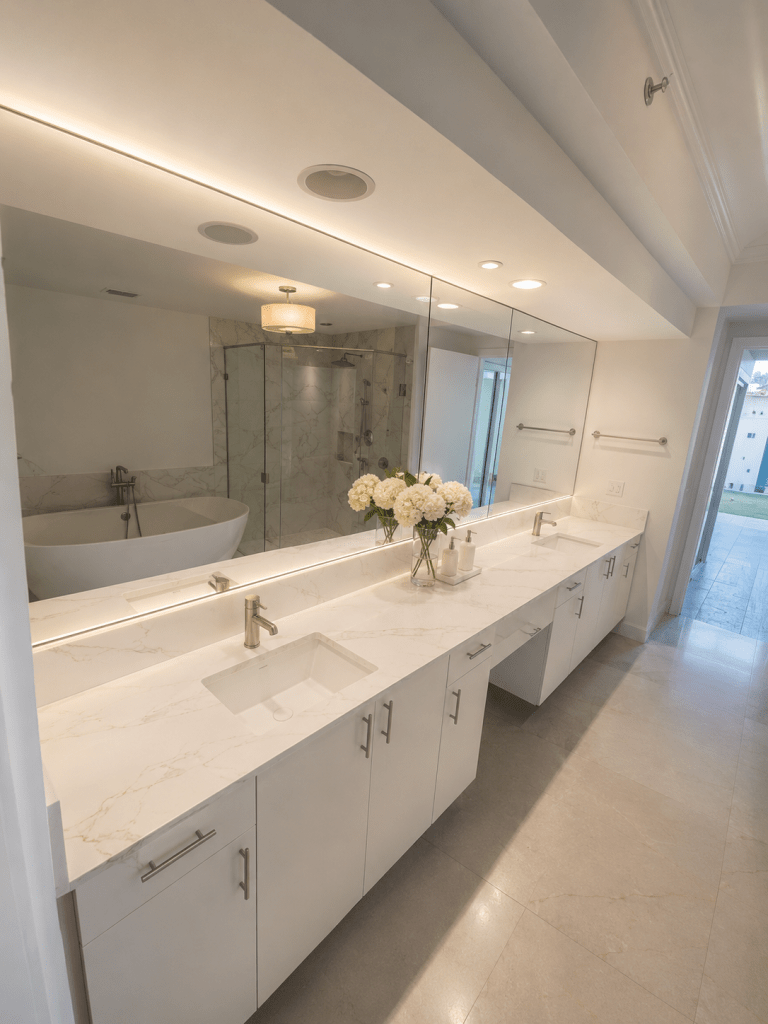
Porcelain handles South Florida bathroom humidity without issue. The zero-porosity surface resists water penetration and biological growth, requires no sealing, and maintains its finish quality in the warm, humid conditions of a Florida bathroom. For buyers who want a consistent, low-maintenance vanity top with a stone-like appearance, porcelain is a direct alternative to quartz with similar performance and a broader range of visual profiles in the premium tile and slab formats.
Caesarstone | Silestone | Cambria | MSI Quartz | Vadara | Viatera | Compac | Pental | Hanstone | Dekton | Neolith
Porcelain occupies a specific position in the countertop material landscape. Understanding where it fits relative to other options helps buyers make the right choice for their specific application.
For indoor applications, porcelain and quartz have similar performance profiles. Both are non-porous, require no sealing, and are highly stain and scratch resistant. The primary differences are aesthetic and thermal. Quartz contains polymer resins that limit its outdoor and high-heat applications. Porcelain has no resin content and is UV-stable and fully heat-resistant. For outdoor applications specifically, porcelain is the clearly superior choice.
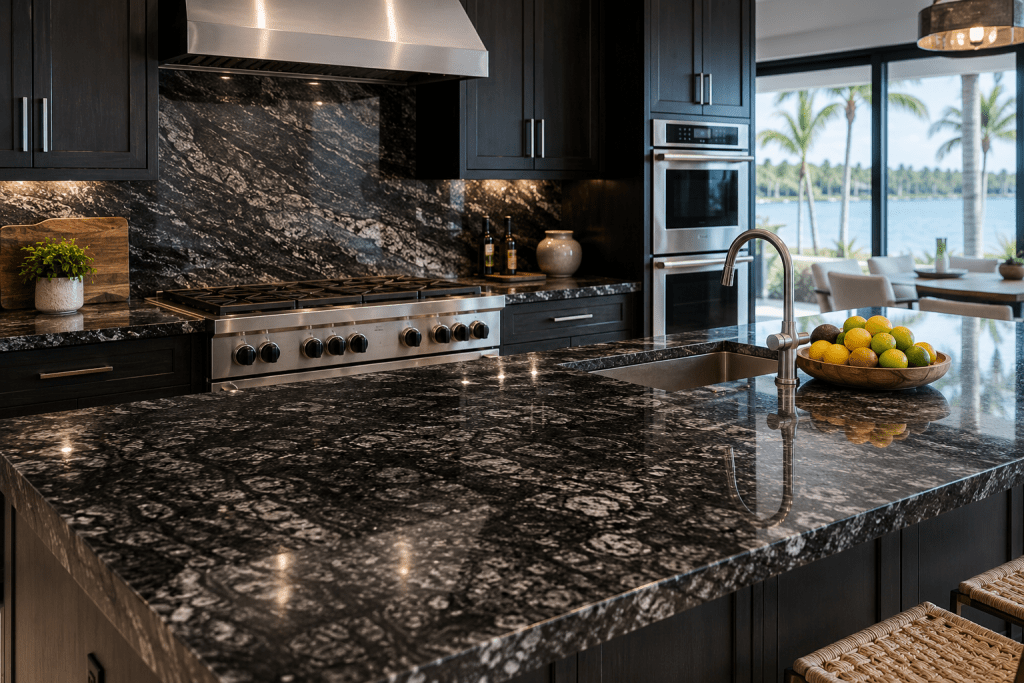
Granite is a proven outdoor material and requires periodic sealing. Porcelain requires no sealing and is UV-stable. For buyers who want an outdoor kitchen surface with zero maintenance obligation, porcelain eliminates the sealing schedule that granite requires. For buyers who want the depth of character and natural variation of genuine stone, granite’s aesthetic is different from anything porcelain can produce.
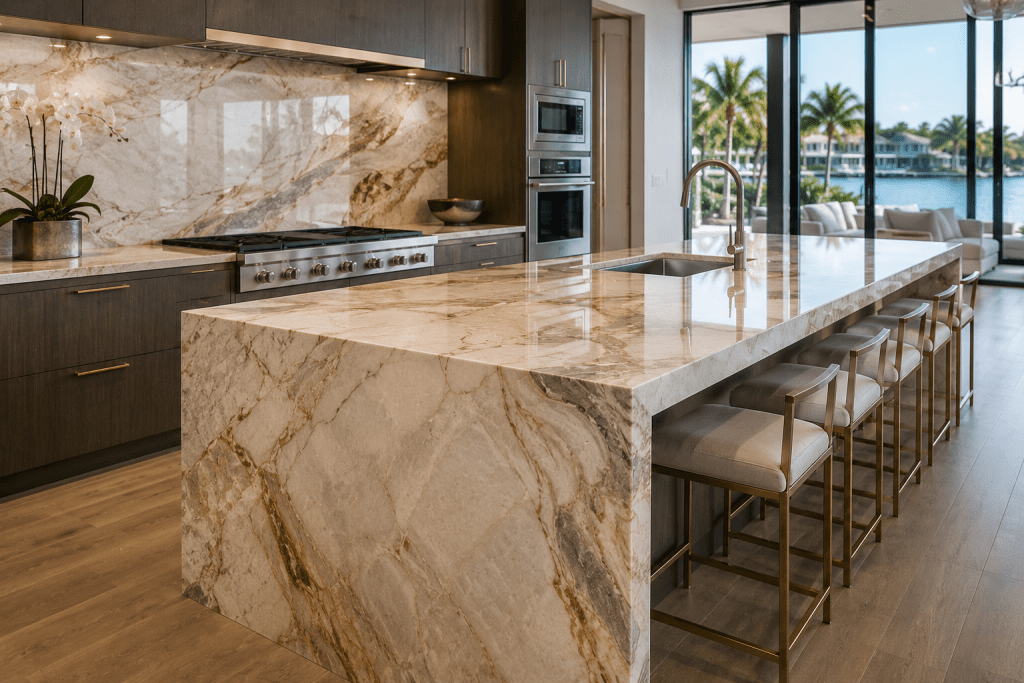
Quartzite is UV-stable and performs well in covered outdoor applications. It requires periodic sealing and has natural variation in every slab. Porcelain requires no sealing and has a more consistent, manufactured appearance. For fully exposed outdoor countertops in direct South Florida sun, porcelain’s UV performance and zero-maintenance profile give it an advantage. For buyers who want natural stone character indoors, quartzite delivers something porcelain cannot fully replicate.
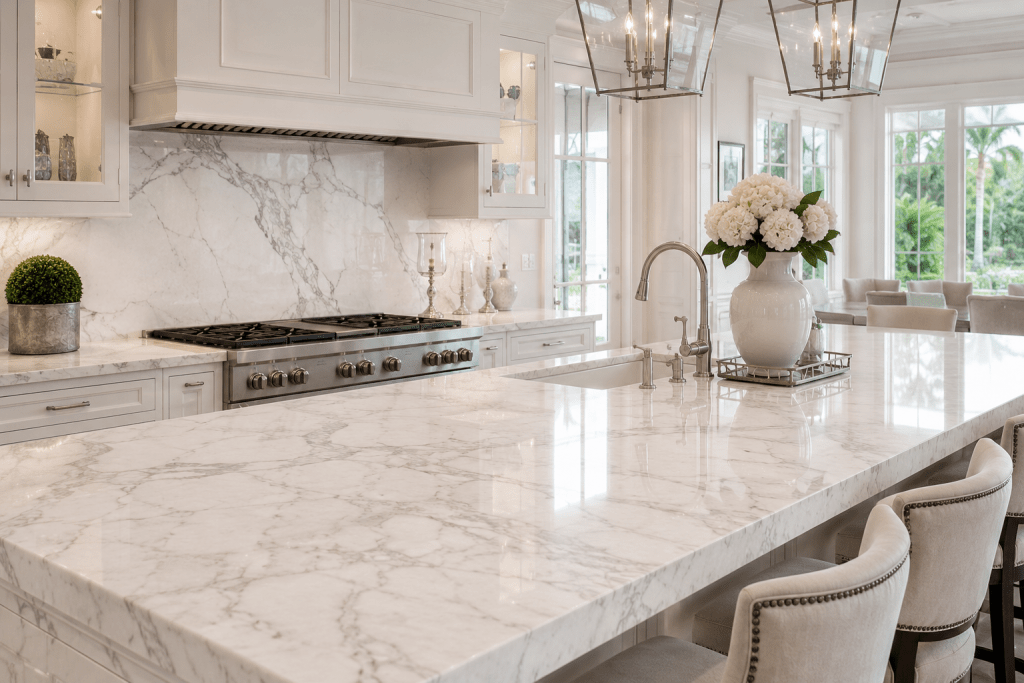
These materials serve different markets. Marble etches from acidic contact and requires frequent sealing in South Florida’s humidity. Porcelain is non-reactive and maintenance-free. For buyers who want a marble-look surface without marble’s maintenance demands, large-format porcelain in marble-look patterns is a direct answer. The two materials do not look identical on a full slab, but porcelain marble-look products have improved significantly and satisfy most buyers who want the aesthetic without the upkeep.
Large-format porcelain slabs used as countertop surfaces are a fundamentally different product from standard ceramic tile. They are produced from a refined clay and mineral blend fired at significantly higher temperatures and under greater pressure, resulting in a denser, harder, fully vitrified surface with zero open porosity. Ceramic tile is softer, more porous, and not designed for countertop applications. Porcelain slabs are fabricated and installed the same way as stone countertops, using diamond tooling to cut to exact dimensions.
Sintered stone is produced by applying extreme heat and pressure to a blend of natural mineral powders without clay as the primary base material. The result is a surface that is denser and harder than traditional porcelain, with a mineral composition that approximates natural stone more closely. Dekton by Cosentino and Neolith are the leading sintered stone products in the South Florida market. In practical terms, both porcelain and sintered stone share the same core performance profile: zero porosity, UV stability, heat resistance, and no sealing required. The differences are in specific hardness levels, aesthetic range, and price point.
Yes. Porcelain is the material we most consistently recommend for outdoor kitchen countertops in South Florida. It is UV-stable, so it will not fade or degrade from direct Florida sun. It is non-porous, so it requires no sealing and is not affected by rain or coastal humidity. It handles direct grill heat without damage and is salt air tolerant. Standard quartz is not recommended for outdoor use in this climate due to UV-related resin degradation. Granite is a proven outdoor alternative but requires periodic sealing that porcelain eliminates entirely.
No. Porcelain is fully vitrified with zero open porosity. There is nothing to seal because there are no pores for a sealer to penetrate. Porcelain requires no sealing at installation and no maintenance sealing over its lifetime. This applies to both indoor and outdoor applications.
Standard large-format porcelain slabs run $55 to $85 per square foot installed. Premium porcelain and sintered stone products including Dekton and Neolith run $85 to $140 per square foot installed. Exact pricing depends on the specific product, slab thickness, your square footage, edge profile, and cutouts. For an accurate number, call us or send photos of your space and we will give you a straight estimate after seeing the job.
Most residential porcelain projects are complete within 5 to 7 business days from the time we template your space. That includes fabrication at our Hallandale Beach facility and installation at your home. Old countertop removal and haul-away are included at no additional charge. We will advise if your specific product or project scope changes that timeline.
Porcelain’s thin profile makes the edges more susceptible to chipping from sharp impacts than thicker natural stone. The surface itself is very hard and resistant to cracking under normal use conditions. Selecting the appropriate edge profile for the application reduces edge chip risk. We advise on edge profile selection at the fabrication stage based on the specific product, thickness, and how the surface will be used.
EXCELLENTTrustindex verifies that the original source of the review is Google. Lee and Melbin are incredibly professional and attentive, always keeping their promises. They offer excellent customer service and have wonderful stones. I highly recommend them!Posted on GoogleTrustindex verifies that the original source of the review is Google. Great experience! I needed to replace my kitchen countertop after the stone cracked. The team was professional, efficient, and had my new countertop installed in less than a week. I’m very happy with the results. Thank you!Posted on GoogleTrustindex verifies that the original source of the review is Google. Excellent service, love m'y New countertops and my waterfallsPosted on GoogleTrustindex verifies that the original source of the review is Google. We recently replaced our old kitchen countertops and the entire experience was excellent! David helped us choose the right stone and color for our kitchen and Melvin kept everything organized and on schedule. The installation team was professional, clean, and very detail-oriented. The seams are barely visible and the finishes look absolutely beautiful. Thanks again!Posted on GoogleTrustindex verifies that the original source of the review is Google. We recently completed a full kitchen remodel with King of Quartz, and the experience was great from start to finish. David and Malvine were amazing to work with, and the staff was professional, responsive, and helpful throughout the entire project. The kitchen came out beautiful, modern, and very clean-looking. Everything from the cabinets to the countertops and finishing details was done with attention and care. Communication was smooth, timelines were explained clearly, and the team made the process feel much less stressful. You can tell they truly care about the quality of their work and customer satisfaction. Highly recommend KOQ for anyone looking to remodel their kitchen.Posted on GoogleTrustindex verifies that the original source of the review is Google. Excellent work right on time affordable price I would recommend it to anyone 100%Posted on GoogleTrustindex verifies that the original source of the review is Google. We took K&P counter tops, we just got our quartz countertop installed. We are very happy with it it's beautiful. David the manager was always responsive, the quartz is perfect for out kitchen. The installation was proffesional, prices are unbeatable as well as the delivery time. Thank youPosted on GoogleTrustindex verifies that the original source of the review is Google. Number one provider of cabinets and graniteVerified by TrustindexTrustindex verified badge is the Universal Symbol of Trust. Only the greatest companies can get the verified badge who has a review score above 4.5, based on customer reviews over the past 12 months. Read more